Ironwood, Michigan · September 24–29, 1926 · A centennial exhibit, 1926–2026
129 Hours
A shaft gave way at the Pabst iron mine. Three men died in its falling cage. Forty-three more waited in the dark on the levels below — and, after five days, walked back into the light.123
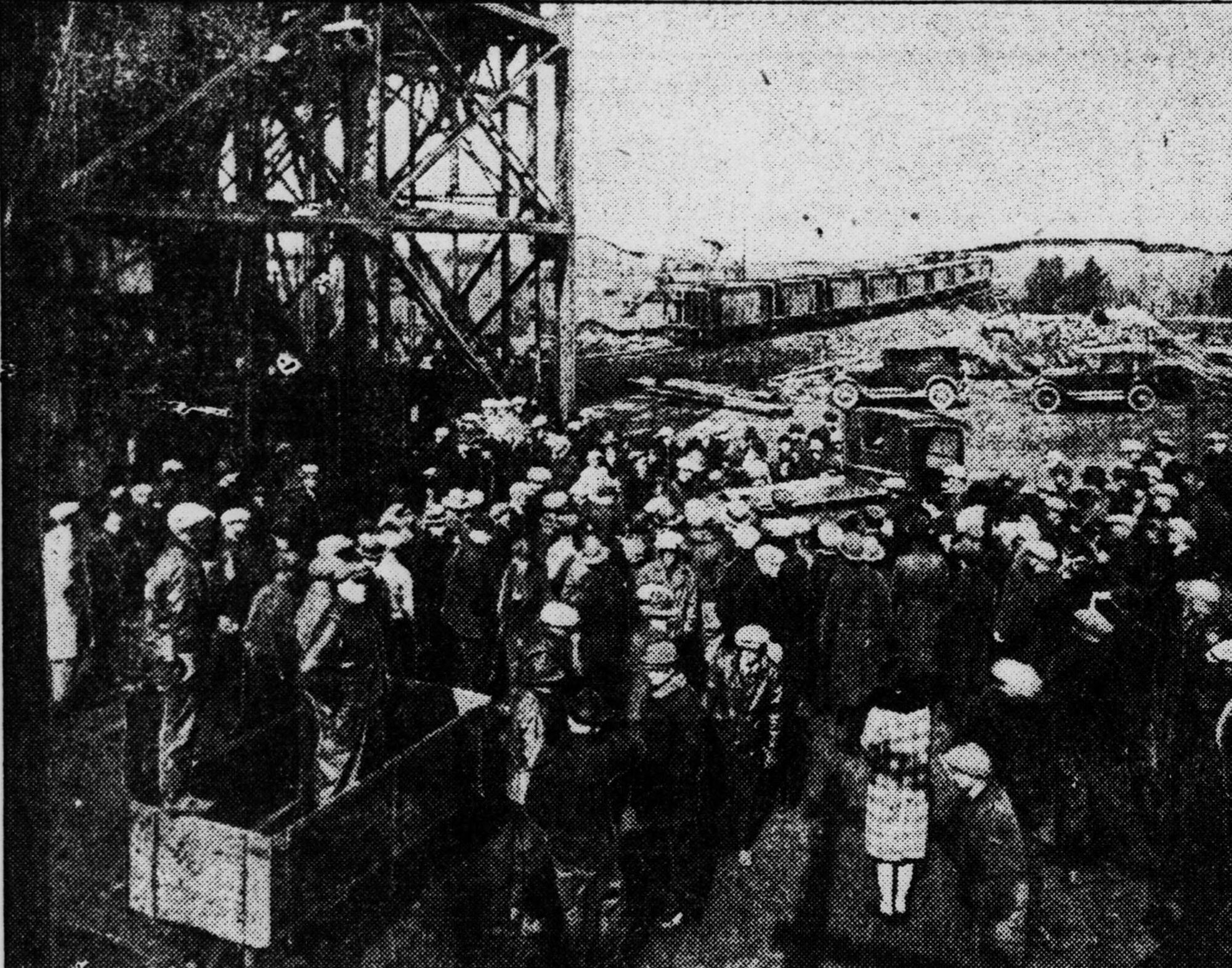
Photograph: families and rescue workers at the Pabst shaft, P. & A. Photos, printed in the Evening Star, Sept. 28, 1926. Public domain; via the Library of Congress.6
Begin the exhibitBefore the rescue story
Three men did not come home
The rescue at Ironwood is remembered as a deliverance. It began with a loss. When the Pabst mine’s G shaft failed on Friday, September 24, 1926, three men riding its cage fell to the bottom of the incline. Associated Press reports named them the next day, with ages as then given:71
- Thomas Rowellunderground electrician · reported age 60
- Evar Gustafsonhis assistant · reported age 35
- Gust Sellhis assistant · reported age 35
Rescuers reached their bodies through another opening on Saturday, before anyone knew whether the forty-three men below were alive.7 Rowell was buried on Monday, September 27; a double funeral for Sell and Gustafson was held the next afternoon in Ironwood’s municipal Memorial Building, while crews underground were still digging.8
Names and spellings are as printed in 1926 wire reports; other papers spelled them “Gustafsen,” “Gustaven” and “Gustav Sell.”98 The Ironwood Globe’s centennial coverage likewise describes the dead as three electricians.4 We found no fuller biographies in rights-cleared sources and have not invented any.
I
The working mine
Ironwood grew on iron. By 1891 six mines worked beneath and beside the town, the Pabst among them. By 1920 the city had 15,739 residents; more than a third were immigrants, and nine in ten had at least one parent born abroad.10 Shift boss Tom Trewartha later told a reporter there had been four nationalities among the trapped men, and that each sang its own songs.11
The Pabst mine took its name from the Milwaukee brewer Frederick Pabst, an early leaseholder, and by 1926 was worked by the Oliver Iron Mining Company, a U.S. Steel subsidiary.51 Its G shaft ran down a steep incline — about 64 degrees, according to local historian Bruce K. Cox as summarized on Wikipedia — for roughly 2,600 feet, with a cage that rode rails along one wall.512
Cox’s account, as summarized there, also records a very wet September and later claims by employees that the shaft walls had bowed and derailed the cage before. We have not been able to check those claims against the book itself, so we mark them as his reconstruction.513
II
Collapse
The AP reported the cave-in at “Friday noon”; the United Press put the cage’s fall on “Friday night”; a Milwaukee paper said “late Friday.”1169 Every account agrees on what followed: tons of rock and earth came down the inclined G shaft, the cage carrying the three electricians fell to the bottom, and the shaft was choked above the level where most of the crew was working.71
Which came first is not settled. One AP version has boulders, loosened by the vibration of machinery, catching the cage and tearing it from its cable. The United Press version has the elevator slipping first, and its crash triggering the cave-in.1716 Wikipedia records the same disagreement.5 We leave it open.
Men on other levels escaped through underground connections to a neighboring mine.7 Those cut off had water dripping from the rock, their lunch pails, and their carbide lamps.913 Early counts wavered: one reprinted dispatch said forty-one men were trapped and two killed; a South Bend headline said forty-six.1718 Within a day the AP settled on forty-three.71
III
Trapped
–
Most of the men were on the eighth level, 727 feet below the surface.812 The historical marker at the H shaft says all forty-three were there. Other accounts place some elsewhere: Wikipedia, citing a local history, gives forty on the eighth level, two on the thirteenth and one on the eighteenth, and an AP dispatch said the first man brought out had been caught alone on the thirteenth.1252
Survivors later told reporters that shift boss Tom Trewartha, a veteran of the iron range, kept order.1911 The men shared out what was left in their lunch pails. They stripped bark from the birch timbers and brewed it into tea over their lamps.21119 They drained kerosene from mine-car lamps, tore clothing for wicks, set up places to sleep and to cook, and marked the passing hours on the rock.191611 They prayed, and they sang in several languages.1911
At the surface, relatives kept watch at the shaft in the cold as a cold wave moved in.7 The Oliver company’s doctor told them the men could live at least two weeks on air and water, and that the warmth of the eighth level was in their favor.8
“Workers have no assurance that the men are alive, efforts to signal them on the pipe line proving futile.”
IV
The rescue route
Step through the five days. This is a schematic built from newspaper descriptions and the H-shaft marker — not a mine survey. Depths and distances are not to scale, and the accounts disagree about the route. Where they differ, we say so.
-
Step 1 of 6 The working shaft
G shaft ran down a steep incline from the surface, its cage carrying men and materials between levels. The H shaft stood about 300 yards to the northeast; underground, the mine’s levels connected with neighboring workings.1257
-
Step 2 of 6 The cage falls
Rock and earth came down the shaft, and the cage with Thomas Rowell, Evar Gustafson and Gust Sell fell to the bottom. The AP described the slide catching the cage; the United Press said the elevator slipped first. The time is reported as noon or night.11716
-
Step 3 of 6 Cut off
The fall choked G shaft above the eighth level, 727 feet down, sealing the men’s way out. Use the switch under the diagram to compare the two accounts of where the forty-three were.8125
-
Step 4 of 6 Four approaches
By September 28 the AP described four efforts at once: A reopening and retimbering G shaft from above; B a drive from the adjoining Aurora mine; C a diamond drill boring a 2½-inch hole to pass down food tablets; and D a crew working up the shaft from the 20th level, half a mile down. Crews changed every four hours.8
-
Step 5 of 6 Breakthrough
Shortly before noon on Wednesday, the AP reported, rescuers coming from below found the ladders to the eighth level in fair condition. They crossed a shaky 30-foot catwalk and reached the men, who asked first for light. The United Press instead credited a tunnel from the Aurora mine. Local memory, from the marker to Miners Memorial Heritage Park, says the rescue came through the H shaft.216123
-
Step 6 of 6 The way out
The men were brought down the ladders to a lower level. George Knoll was credited with guiding them. They were then hoisted in groups up the adjoining shaft, where the crowd was waiting. Trewartha left the shaft at 9:30 p.m. The AP reported the rescue complete at 11:20 p.m.; Wikipedia says 11:22. The commonly cited 129 hours depends on which start and end times a source uses.2021253
V
The return
News that the men were alive set off the town’s sirens and horns. When the first man reached the surface, the AP wrote, he was met by cheers, ringing bells and blowing whistles. Police held back the crowd, and families pressed against the guard ropes.2
Reports disagree on who came up first. One AP dispatch named Samuel F. Synkelman, 38, a father of eight; the United Press spelled his name Snyklema and also put him first.219 Another AP dispatch said shift boss Trewartha was the first of the group to leave the mine, at 9:30 p.m. He collapsed soon after reaching the surface.22119 The men came up in groups through the adjoining shaft, and the AP reported the rescue complete at 11:20 p.m.21 They were examined in the mine rescue car and taken to Ironwood’s Grandview Hospital. By the next day, doctors expected all of them to recover.21911
How many people watched is uncertain. The AP’s night dispatch estimated ten thousand; the marker at the H shaft says seven thousand; Wikipedia, citing a local history, says as many as five thousand. We have not chosen among them.2125
The story ran across the country. Library of Congress newspaper scans alone turn up the rescue in papers from Maine to Arizona to Alaska within days.23
VI
Memory
1926 – 2026
The relief did not settle every question. Within a day, the managing editor of the Ashland (Wis.) Daily Press called on state and federal agencies to investigate the condition of the shaft. A labor paper later reported that the Press had telegraphed President Coolidge, charging that the shaft had long been dangerous.1124 Decades later Cox wrote that about half of the rescued men accused the Oliver company of sending them to work in a shaft it knew to be unsafe.13 Those charges belong to the record as charges. We found no official finding in the sources we could consult.
Ironwood has kept the memory closer than the national press did. Relatives of the trapped men have gathered for annual vigils; in 2013, at the fifth, interpretive signs were unveiled at the G and H shafts.25 A marker stands at the H shaft on Bonnie Street, and the mine site is now part of Miners Memorial Heritage Park.124
For the centennial, the park and the town planned a roundtable with historian Larry Peterson and author Bruce Cox on September 24, 2026; guided tours of the G and H shaft sites on September 26; and an evening program, Echoes from the Eighth Level, at the Memorial Building. It appears to be the same building where Sell and Gustafson were mourned in 1926 (our inference from the 1926 report).438
Chronology
Timeline
Times are as reported and sometimes conflict. Filter to focus on the week underground or on what came after.
-
1891
Six mines around Ironwood
The Pabst is among six mines operating in Ironwood, employing over 3,000 men.10
-
1920
An immigrant city
Ironwood counts 15,739 residents, more than 37 percent of them immigrants.10
-
Three bodies recovered
Rescuers reach the cage through another shaft. Relatives gather at the collar in falling temperatures.7
-
Thomas Rowell is buried
Reported in an AP dispatch the following day.8
-
Four approaches; a double funeral
Crews work from above, from the Aurora mine, by diamond drill, and up from the 20th level. Sell and Gustafson are mourned in the Memorial Building.8
-
The men are reached
Rescuers cross a 30-foot catwalk to the eighth level and find the men alive.2
-
Recovering; calls for inquiry
The men rest in Grandview Hospital. An Ashland editor calls for a state and federal investigation of the shaft.11
-
2006
Perfectly Safe
Bruce K. Cox publishes a book-length local history of the disaster.13
-
Fifth annual vigil
New signs are unveiled at the G and H shafts.25
Primary media
The archive
Every image stored on this site is public domain in the United States.26 Each one is labeled by type. Event photographs and pages are from 1926. Composites were arranged by newspapers. Context images were made years earlier and are not of this disaster. Select any image to enlarge it and read its provenance.
Seen elsewhere — linked, not reproduced
These records show the event or the site, but we have no documented right to copy them. Follow the links to view them where their holders publish them.
-
Event photograph · 1926
Rescued miners from the Pabst Iron Mine
Robert Sennecke / ullstein bild, published in Zeitbilder 42/1926. Commercial rights claimed by Getty Images.27
View at Getty Images (opens in a new tab) ↗ -
Historic photograph · date not stated
“Miners in front of Shaft G of the Pabst Mine”
Gallery image on the City of Ironwood’s history page. Rights not stated.10
View at City of Ironwood (opens in a new tab) ↗ -
Site photographs · 2011
The H-shaft marker and shaft
Photographs by Paul Fehrenbach with a transcription of the marker, on HMdb.org.12
View at HMdb (opens in a new tab) ↗ -
Newspaper pages · 1926
75 more pages in Chronicling America
Full pages from the Library of Congress collection, searchable and free to read.23
Search the collection (opens in a new tab) ↗
Method
How we know — and where we don’t
This exhibit rests mainly on 1926 newspaper reports carried by three competing wire services: the Associated Press, the United Press and the International News Service. We checked those reports against local institutions: the H-shaft historical marker, the City of Ironwood, Miners Memorial Heritage Park and the Ironwood Globe. Wikipedia is used only where noted. Early wire copy was written against deadlines and repeated live counts that later changed. Where sources disagree, we show the disagreement instead of choosing a side.
How many were trapped, and where?Disputed
The H-shaft marker says all 43 were on the eighth level, 727 feet down.12 Wikipedia, citing Matthew Liesch’s Ironwood, Hurley, and the Gogebic Range (2006, not consulted by us), gives 40 on the eighth, two on the thirteenth and one on the eighteenth.5 An AP dispatch said the first man out had been caught alone on the thirteenth and was brought up by way of the eighth.2 Early reports said 41 trapped, and one headline said 46.1718
Did the rock fall first, or the cage?Disputed
The AP described boulders, loosened by machinery vibration, catching the cage and tearing it from its cable.171 The United Press said the elevator slipped and its crash probably caused the cave-in.16 Wikipedia notes that sources disagree.5 Accounts also differ on whether the cage was going down or coming up: the AP wrote that the men were being carried “to the surface,” while Wikipedia says they were descending.15
When did it happen, and why “129 hours”?Uncertain
Reports put the cave-in at Friday noon (AP), “late Friday” (Milwaukee Leader) or Friday night (UP).1916 From noon Friday, 129 hours runs to about 9 p.m. Wednesday. That is close to Trewartha’s reported exit at 9:30 p.m. The AP put the rescue’s completion at 11:20 p.m., and Wikipedia gives 11:22 p.m. for the last man out.2215 We treat 129 hours as the long-established commemorative figure, used by the park, the Ironwood Globe and Wikipedia, rather than a measured duration.345 (The arithmetic here is our inference.)
How deep, and how far did the cage fall?Varies
The AP and the marker give 727 feet for the eighth level.812 The Evening Star’s photo caption said 400 feet, and a Maine headline said 1,200.621 The marker says the cage fell 2,600 feet. That matches the length of the inclined shaft as summarized from Cox; it is a distance along the slope, not a vertical drop.125
Which route actually reached the men?Disputed
The AP described a crew working up from the deep levels, climbing the ladders to the eighth and crossing a 30-foot catwalk. It said the men were then taken down to a lift.220 The United Press credited a tunnel from the Aurora mine.16 The AP also reported that the men were lifted out through an adjoining shaft. The marker, the park and Wikipedia describe the rescue from the neighboring H shaft.211235 Our schematic follows the AP and local account and marks the Aurora approach as one of four efforts.
How many people watched?Disputed
Ten thousand (AP, night of the rescue), seven thousand (H-shaft marker), and as many as five thousand (Wikipedia, citing Liesch).2125 None was a count. We attribute every figure and settle on none.
What about the “Detroit News, 1923” citation?Citation error
Wikipedia cites a Detroit News retrospective, “The Great Escape at Ironwood,” with the year 1923. That cannot be right for a 1926 event, and the original page is offline. We do not rely on that citation for any statement here.5
What is illustration, and what is inference?Labels
The Washington Times “photo-diagram” was “arranged from a description.” We show it as an example of 1926 media, not as a record.11 The postcards are from about 1905–1910 and show other Ironwood mines. Our shaft diagram is a schematic drawn from newspaper descriptions and is not to scale. Statements that combine sources, such as the 129-hour arithmetic, are marked as inference. We quote only text we read on the page image. We have not quoted OCR text or invented dialogue.
Apparatus
Sources
Numbered in order of first citation. Each entry says what we used it for. 1926 primary local institution secondary encyclopedia off-site media context image rights
- 1926 primary “43 Miners Entombed in Shaft; Await Assistance” (opens in a new tab) The Daily Iowan (Iowa City), p. 1 — Associated Press dispatch dated Ironwood, Sept. 25 · 1926-09-26 Held by: University of Iowa Libraries, Daily Iowan Historic Newspapers Used for: More than 700 feet below the surface; 43 miners of the Oliver Iron Mining Company entombed ‘Friday noon’; rescuers in double eight-hour relays; the lift fell to the shaft bottom; victims identified as Thomas Rowell, 60, underground electrician, and two assistants, Evar Gustafson, 35, and Gust Sell, 35. Cited 15×
- 1926 primary “43 Men Taken From Mine; All Alive and Well” (opens in a new tab) Douglas Daily Dispatch (Douglas, Ariz.), p. 1 — Associated Press dispatches dated Sept. 29 · 1926-09-30 Held by: Library of Congress, Chronicling America Used for: Men found alive half a mile underground; rescuers crossed a shaky 30-foot ‘cat walk’; birch-bark tea brewed over miners’ lamps; first man out named as Samuel F. Synkelman, 38, father of eight, caught alone on the 13th level; shift boss Thomas Trewartha left the shaft at 9:30 p.m.; ‘Ten thousand persons’ near the shaft. Cited 18×
- local institution Events — Pabst Mine centennial (opens in a new tab) Miners Memorial Heritage Park (Friends of MMHP), Ironwood · accessed 2026-09-24 Held by: Friends of Miners Memorial Heritage Park Used for: Three killed and 43 trapped at G shaft; 129 hours; reached from the neighboring H shaft; Sept. 26, 2026 centennial site tour at G and H shafts and the program ‘Echoes from the Eighth Level’. Cited 8×
- local institution “Pabst Mine Cave-in 100-year Commemoration Event Schedule” (opens in a new tab) The Globe (Ironwood Daily Globe) · 2026-09-24 Held by: The Globe Used for: The cave-in killed three electricians and trapped 43 miners until rescue 129 hours later; centennial roundtable (Sept. 24) and events (Sept. 26). Cited 7×
- encyclopedia Pabst Mine disaster (opens in a new tab) Wikipedia (English), revision current on 2026-09-24 · accessed 2026-09-24 Held by: Wikimedia Foundation Used for: G shaft sunk on a 64° incline to nearly 2,600 ft (citing Cox); heavy September rain (Cox); sources disagree whether the elevator or rock fell first; 40 trapped on the 8th level, two on the 13th, one on the 18th (citing Liesch); ‘as many as 5,000’ watching (Liesch); last man out 11:22 p.m. Also cites a Detroit News retrospective with the year ‘1923’ — an evident citation error. Cited 20×
- 1926 primary Photograph: “Keeping Vigil Where 43 Miners Are Entombed” (opens in a new tab) Evening Star (Washington, D.C.), p. 17 — photo credited “Copyright by P. & A. Photos” · 1926-09-28 Held by: Library of Congress, Chronicling America Used for: Published photograph of rescue workers and family members at the Pabst shaft. Its caption gives the depth as 400 feet — lower than the 700-plus feet in AP text reports. Cited 3×
- 1926 primary “Find Three Bodies in Mine Disaster; 43 Still Trapped” (opens in a new tab) Evening Star (Washington, D.C.), p. 1 — Associated Press dispatch · 1926-09-25 Held by: Library of Congress, Chronicling America Used for: Bodies of the three cage occupants recovered on Sept. 25 through another shaft; victims believed by mine officials to be Thomas Rowell, underground electrician, and assistants Evar Gustafson and Gust Sell; relatives kept vigil at the shaft in falling temperatures; other men working different levels escaped through connections to an adjoining mine. Cited 9×
- 1926 primary “Much Work Yet Remains for Rescuers” (opens in a new tab) The Union Daily Times (Union, S.C.), p. 1 — Associated Press dispatches dated Sept. 28 and 29 · 1926-09-29 Held by: Library of Congress, Chronicling America Used for: Eighth level 727 feet below the surface; four rescue efforts — reopening the shaft, a crew working up from the 20th level, a drive from the adjoining Aurora mine, and a diamond drill boring a 2½-inch hole for food tablets; double funeral for Gust Sell and Evar Gustafsen in the municipal Memorial Building; Thomas Rowell buried the day before. Cited 10×
- 1926 primary Front-page report on the Ironwood cave-in [headline paraphrased] (opens in a new tab) The Milwaukee Leader, morning edition, p. 1 · 1926-09-26 Held by: Library of Congress, Chronicling America Used for: Separate report naming the dead as Thomas Rowell, electrician, and his assistants (spelled ‘Gustafson’ and ‘Gustav Sell’); describes a ‘late Friday’ cave-in and a cable snapped by falling rock; notes broken telephone wires cut off communication. Cited 4×
- local institution History of Ironwood (opens in a new tab) City of Ironwood, Michigan · accessed 2026-09-24 Held by: City of Ironwood Used for: Pabst among Ironwood’s early mines; 1920 population 15,739; more than 37% of residents immigrants and over 90% with at least one foreign-born parent. Hosts a photograph captioned ‘Miners in front of Shaft G of the Pabst Mine’ (not reproduced here). Cited 4×
- 1926 primary “Photo-Diagram Showing How Rescuers Succeeded in Saving Entombed Miners” and “43 Miners From Tomb; All Will Recover” (opens in a new tab) The Washington Times, p. 3 — International News Service (Howard G. Mayer) · 1926-09-30 Held by: Library of Congress, Chronicling America Used for: Composite ‘photo-diagram … arranged from a description’; INS report that the men shared lunches, made birch-bark tea, organized camps for sleeping and cooking, and sang in their own languages; Ashland Daily Press editor called for state and federal inquiry into the shaft. Cited 10×
- local institution Pabst Mine “H” Shaft historical marker (opens in a new tab) The Historical Marker Database (HMdb.org), marker 45051; photographs by Paul Fehrenbach, 2011 · page revised 2020-11-25 Held by: HMdb.org transcription of the on-site marker Used for: G shaft ~300 yards southwest of the H shaft; three men in the cage fell 2,600 feet; 43 men trapped on the 8th level, 727 feet below the surface; ‘7,000 people’ gathered at H shaft five days later. Cited 15×
- secondary Perfectly Safe: The Pabst Mine Disaster of 1926 (publisher’s listing) (opens in a new tab) Bruce K. Cox, Agogeebic Press (2006) — listing at GogebicBooks.com · 2006 Held by: GogebicBooks.com Used for: Book-length local history. Listing summary: the hanging wall of G shaft collapsed; men lived on lunches, dripping water and birch-bark tea; survivors reached Sept. 29; about half later accused the Oliver Iron Mining Company of knowingly working an unsafe shaft. (We consulted the listing, not the full book.) Cited 4×
- context image “Ready for Work,” Norrie Mine, Ironwood, Mich. (postcard, c. 1905) (opens in a new tab) Wikimedia Commons — File:Ironwood-mining03-1910.jpg · c. 1905 Held by: Wikimedia Commons (public domain) Used for: Contextual image of Ironwood miners two decades before the disaster. Not the Pabst mine and not 1926. Cited 1×
- context image “Underground Mining Scene, Ironwood, Mich.” (postcard, Davis & Fehr, c. 1910) (opens in a new tab) Wikimedia Commons — File:Ironwood-mining01-1910.jpg · c. 1910 Held by: Wikimedia Commons (public domain) Used for: Contextual image of underground work on the Gogebic Range. Not the Pabst mine and not 1926. Cited 1×
- 1926 primary “Where Miners Were Rescued” and continuation of the rescue report (opens in a new tab) The Washington Daily News, p. 3 — United Press · 1926-09-30 Held by: Library of Congress, Chronicling America Used for: United Press account crediting the successful approach to a tunnel from the Aurora mine; states the elevator slipped ‘Friday night’ and its crash is believed to have caused the cave-in; men weakened by hunger brought down improvised rope ladders; men tracked the hours on the rock walls. Cited 9×
- 1926 primary “41 Miners Are Trapped When Boulders Fall” (opens in a new tab) The Watchman and Southron (Sumter, S.C.), p. 1 — early Associated Press dispatch · 1926-09-29 Held by: Library of Congress, Chronicling America Used for: Example of an early, since-superseded count (41 trapped, two believed killed) reprinted days after the event; describes the cage catching the first rush of boulders and being torn from its cable. Cited 5×
- 1926 primary Photograph: “Mine Blast Traps 46” (opens in a new tab) South Bend News-Times, p. 4 — photo credited NEA · 1926-09-29 Held by: Library of Congress, Chronicling America Used for: Caption: three men killed and 43 trapped; ‘relatives of the entombed men grouped about the mine shaft as the bodies of the three dead men were brought to the surface.’ The headline’s ‘blast’ was not how other reports described the cave-in. Cited 3×
- 1926 primary Front-page report on shift boss Tom Trewartha and the survivors [headline paraphrased] (opens in a new tab) The Washington Daily News, p. 1 — United Press · 1926-09-30 Held by: Library of Congress, Chronicling America Used for: Survivors credit shift boss Tom Trewartha with preventing panic; birch-bark tea; kerosene drained from mine-car lamps with torn garments as wicks; men sang and prayed; Sam Snyklema, father of eight, first brought to the surface. Cited 7×
- 1926 primary Report on rescuer George Hawes’s return to Chicago [headline paraphrased] (opens in a new tab) Evening Star (Washington, D.C.), p. 2 — Associated Press, Chicago · 1926-10-02 Held by: Library of Congress, Chronicling America Used for: George Hawes, reported as the first man up the ladder to the entombed men, deflected praise to George Knoll, who brought the miners down the shaft ladder so they could be taken to the lift. Cited 3×
- 1926 primary “Miners Up From Depths” / “43 Rescued After 5 Days in Deep Shaft” (opens in a new tab) Daily Kennebec Journal (Augusta, Me.), p. 1 — Associated Press dispatch dated Sept. 29 · 1926-09-30 Held by: Library of Congress, Chronicling America Used for: Rescue ‘completed at 11:20 o’clock tonight,’ every man ‘lifted to the surface through an adjoining shaft’; miners hoisted in groups; Trewartha described as the first man to greet the waiting crowd; a deck headline gives the depth as ‘1200 feet.’ Cited 7×
- context image “Aurora Mine, Ironwood, Mich.” (postcard, E.C. Kropp Co., c. 1910) (opens in a new tab) Wikimedia Commons — File:Ironwood-Aurora-1910.jpg · c. 1910 Held by: Wikimedia Commons (public domain) Used for: The Aurora was the neighboring mine named in 1926 rescue reports. Contextual image, c. 1910 — not of the disaster. Cited 1×
- 1926 primary Chronicling America search: “pabst ironwood miners”, Sept. 24 – Oct. 15, 1926 (opens in a new tab) Library of Congress · accessed 2026-09-24 Held by: Library of Congress Used for: 75 digitized newspaper pages from at least 20 titles — from Maine and South Carolina to Arizona and Alaska — carrying the story within three weeks. Cited 2×
- 1926 primary Report on the Ashland Daily Press demand for an Ironwood probe [headline paraphrased] (opens in a new tab) The Daily Worker (New York edition), p. 2 · 1926-10-03 Held by: Library of Congress, Chronicling America Used for: Reports that the Ashland (Wis.) Daily Press telegraphed President Coolidge demanding a federal investigation, charging the shaft had been in dangerous condition. A partisan labor paper, cited for the demand, not as proof of the charges. Cited 2×
- local institution “New signs unveiled at Pabst Mine disaster vigil” (opens in a new tab) The Globe (Ironwood Daily Globe) · 2013-09-26 Held by: The Globe Used for: Fifth annual vigil in 2013, attended by relatives of trapped miners; interpretive signs unveiled at the G and H shafts. Cited 2×
- rights Chronicling America: Rights and Access (opens in a new tab) Library of Congress · accessed 2026-09-24 Held by: Library of Congress Used for: The Library believes the newspapers in Chronicling America are in the public domain or have no known copyright restrictions. Cited 1×
- off-site media Rescued miners from the Pabst Iron Mine, Ironwood, Michigan, 1926 (Robert Sennecke / ullstein bild) (opens in a new tab) Getty Images editorial listing 549415253; published in Zeitbilder 42/1926 · 1926 Held by: Getty Images / ullstein bild Used for: Event photograph available for viewing off-site only. Not reproduced: foreign publication and an active commercial rights claim. Cited 1×